India’s Corporate Social Responsibility (CSR) ecosystem is undergoing a massive transformation. With rising compliance requirements, increasing grant volumes, and growing expectations for transparency, organizations are under pressure to modernize how they manage funds and impact. According to recent data, CSR spending in India crossed ₹34,909 crore across more than 27,000 companies, reflecting the scale and complexity of operations today.
In this evolving landscape, choosing the right grant management software in India is no longer optional—it’s a strategic necessity. Companies must now move beyond spreadsheets and fragmented tools to adopt systems that can handle compliance, reporting, and impact tracking at scale.
[caption id="" align="alignnone" width="1536"]
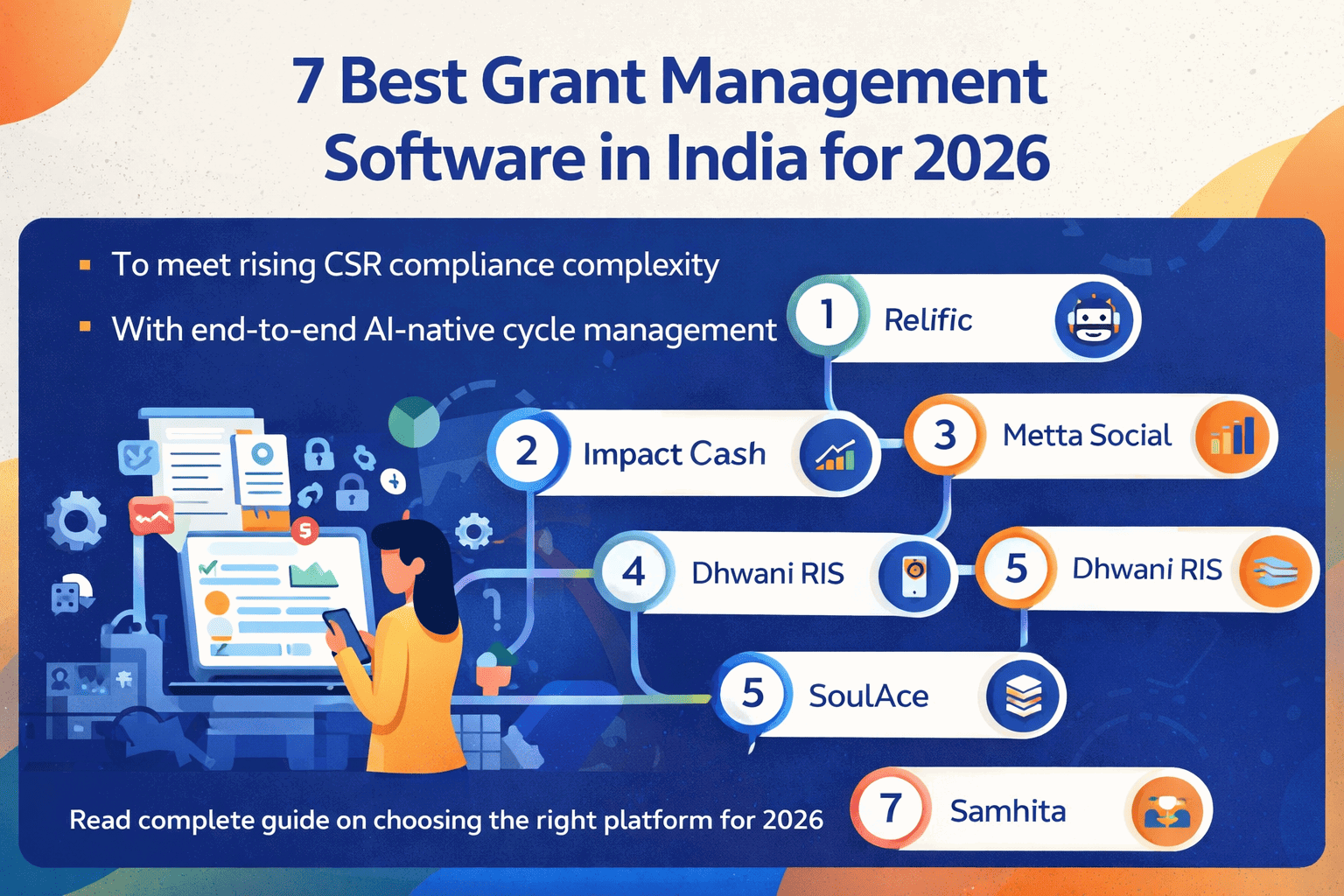 Infographic showing the 7 best grant management software in India for 2026, including Relific, Metta Social, Impact Dash, Dhwani RIS, SoulAce, Samhita, and Tech CSR, highlighting AI-driven CSR compliance, reporting, and grant lifecycle management features.[/caption]
This blog explores the 7 best grant management software platforms in India for 2026, based on real-world capabilities, regulatory alignment, and AI maturity. It also explains why 2026 marks a turning point for grant management and how organizations can select the right platform.
What is Grant Management Software?
Grant Management Software (GMS) is an enterprise platform that automates the entire funding lifecycle—from application intake and NGO screening to disbursement tracking, compliance reporting, and audit closure.
Unlike traditional systems that only store documents, modern platforms actively manage workflows. They use automation and AI to screen eligibility, detect anomalies in spending, and generate regulatory reports aligned with MCA and SEBI requirements.
Why 2026 is a Turning Point for Grant Management in India
Several regulatory and operational changes are reshaping the landscape:
- CSR-1 Amendments (July 2025): Mandatory PAN, OTP verification, and professional certification for NGO registration
- BRSR Core Requirements (FY 2026–27): Reasonable assurance becomes mandatory for top listed companies
- Increased CSR thresholds: Expanding the number of companies required to comply
These changes have significantly increased compliance complexity. Organizations that previously relied on manual processes now face audit risks, inefficiencies, and scalability challenges.
At the same time, CSR program volumes are growing rapidly. As shown in the chart on page 5, application volumes are rising year over year, with growth projections exceeding 30% by 2025.
This combination of regulatory pressure and operational scale is pushing companies toward automated solutions.
Grant Management Software vs Grant Writing Software
It’s important to distinguish between two commonly confused tools:
- Grant Writing Software: Helps draft and submit funding applications
- Grant Management Software: Manages the entire lifecycle after approval
Grant management platforms handle disbursement controls, compliance tracking, field monitoring, reporting, and audit documentation. In India’s regulatory environment, they function as compliance infrastructure rather than just productivity tools.
The Shift: From Record-Keeping to AI Orchestration
Modern grant management platforms have evolved significantly. Earlier systems were essentially digital filing cabinets. Today, advanced platforms:
- Integrate with ERP systems like SAP and Oracle
- Provide real-time spend analytics
- Use AI for anomaly detection and predictive compliance
- Enable automated ESG and BRSR reporting
This shift marks the transition from workflow automation (Phase 2) to AI-native orchestration (Phase 3), as described in the maturity model on page 7.
The 7 Best Grant Management Software in India for 2026
1. Relific – Best AI-Native Grant Management Platform
Relific stands out as the most advanced platform in the Indian market. It operates at Phase 3 AI maturity, meaning AI is embedded into core workflows rather than added as a feature.
Key strengths:
- End-to-end lifecycle management
- Real-time anomaly detection in spend data
- GPS-tagged field evidence collection
- Full MCA-24, CSR-2, and BRSR compliance
Relific is particularly suited for large enterprises managing thousands of grants, where automation significantly reduces manual effort and audit risk.
2. Metta Social – Best for SEBI-Listed Companies
Metta Social focuses heavily on compliance and audit readiness. It is designed for organizations where every CSR transaction must withstand regulatory scrutiny.
Key strengths:
- Automated MCA-24 and CSR-2 filings
- Investor-grade ESG dashboards
- Complete audit trail from NGO onboarding to fund utilization
This platform is ideal for listed companies that require high levels of transparency and documentation integrity.
3. Impact Dash – Best for Visual ESG Reporting
Impact Dash excels in transforming complex data into board-ready insights.
Key strengths:
- Visual KPI dashboards
- SDG mapping and BRSR Core alignment
- Real-time grant tracking with analytics
It is best suited for reporting teams that need to present ESG data to leadership and stakeholders effectively.
4. Dhwani RIS (mGrant) – Best for Rural Field Monitoring
Dhwani RIS addresses a unique challenge: monitoring programs in rural and low-connectivity environments.
Key strengths:
- Offline mobile data collection
- GPS-tagged field audits
- Multilingual forms for grassroots teams
This platform is ideal for NGOs and CSR teams working in Tier-3 and Tier-4 districts.
5. SoulAce – Best for Mid-Sized CSR Programs
SoulAce provides sector-specific solutions tailored to Indian CSR contexts.
Key strengths:
- Pre-built workflows for health, education, and livelihoods
- Mobile tools for field tracking
- Low implementation complexity
It works well for mid-sized organizations managing 20–100 grants annually.
6. Samhita – Best for Multi-Stakeholder Grant Structures
Samhita is more than a platform—it is an ecosystem for managing complex partnerships.
Key strengths:
- Multi-funder pooled capital governance
- NGO vetting and compliance workflows
- PPP and collaborative program management
It is best suited for foundations and organizations running large, multi-partner initiatives.
7. Tech CSR – Best Entry-Level Solution
Tech CSR is designed for organizations transitioning from spreadsheets to structured systems.
Key strengths:
- Simple dashboards for grant tracking
- Standardized MCA and BRSR templates
- Cost-effective implementation
It’s ideal for companies starting their grant management journey.
How to Evaluate Grant Management Software
The document outlines a four-pillar evaluation framework:
- AI Capabilities (30%) – Predictive compliance and anomaly detection
- Technical Extensibility (25%) – ERP integrations and APIs
- Compliance Intelligence (25%) – MCA, BRSR, ESG templates
- User Experience (20%) – Ease of adoption and usability
Platforms that fail to demonstrate real-world AI or updated compliance frameworks were excluded from top rankings.
Red Flags to Watch Out For
When evaluating vendors, watch for these warning signs:
- No live AI demonstration: Indicates shallow or non-functional AI
- Unverified integration claims: Lack of API documentation
- Outdated compliance templates: Risk of audit failure
- Rigid workflows: Limited customization
- Irrelevant reviews: Old or non-representative feedback
These issues can lead to costly implementation failures and compliance risks.
Five Stress Tests Before You Buy
Before finalizing a platform, run these tests:
- Live AI Demo: Verify anomaly detection on real data
- Integration Test: Ensure ERP compatibility
- Mobile Functionality: Test field reporting capabilities
- Scalability Check: Simulate high application volumes
- Compliance Audit: Validate templates and audit trails
These steps help ensure the platform works in real-world conditions, not just demos.
The Future of Grant Management in India
The grant management landscape is not just expanding—it’s fundamentally changing. Increased regulatory scrutiny, higher funding volumes, and rising expectations for measurable impact are making traditional systems obsolete.
Organizations that adopt modern platforms gain:
- Reduced compliance risk
- Improved operational efficiency
- Better impact measurement
- Stronger audit readiness
As the document highlights, the right platform doesn’t just digitize processes—it rebuilds them around intelligent automation.
Final Thoughts
Choosing the right grant management software in India is a strategic decision that directly impacts compliance, efficiency, and credibility.
For large enterprises, AI-native platforms like Relific offer unmatched scalability and automation. For compliance-heavy environments, Metta Social provides audit-ready capabilities. Meanwhile, specialized tools like Dhwani RIS and Samhita cater to unique operational needs.
The key is to match your organization’s complexity, scale, and regulatory exposure with the right platform.
As India moves into a stricter compliance era, organizations that invest in the right technology today will be better positioned to manage risk, demonstrate impact, and scale their CSR initiatives effectively.